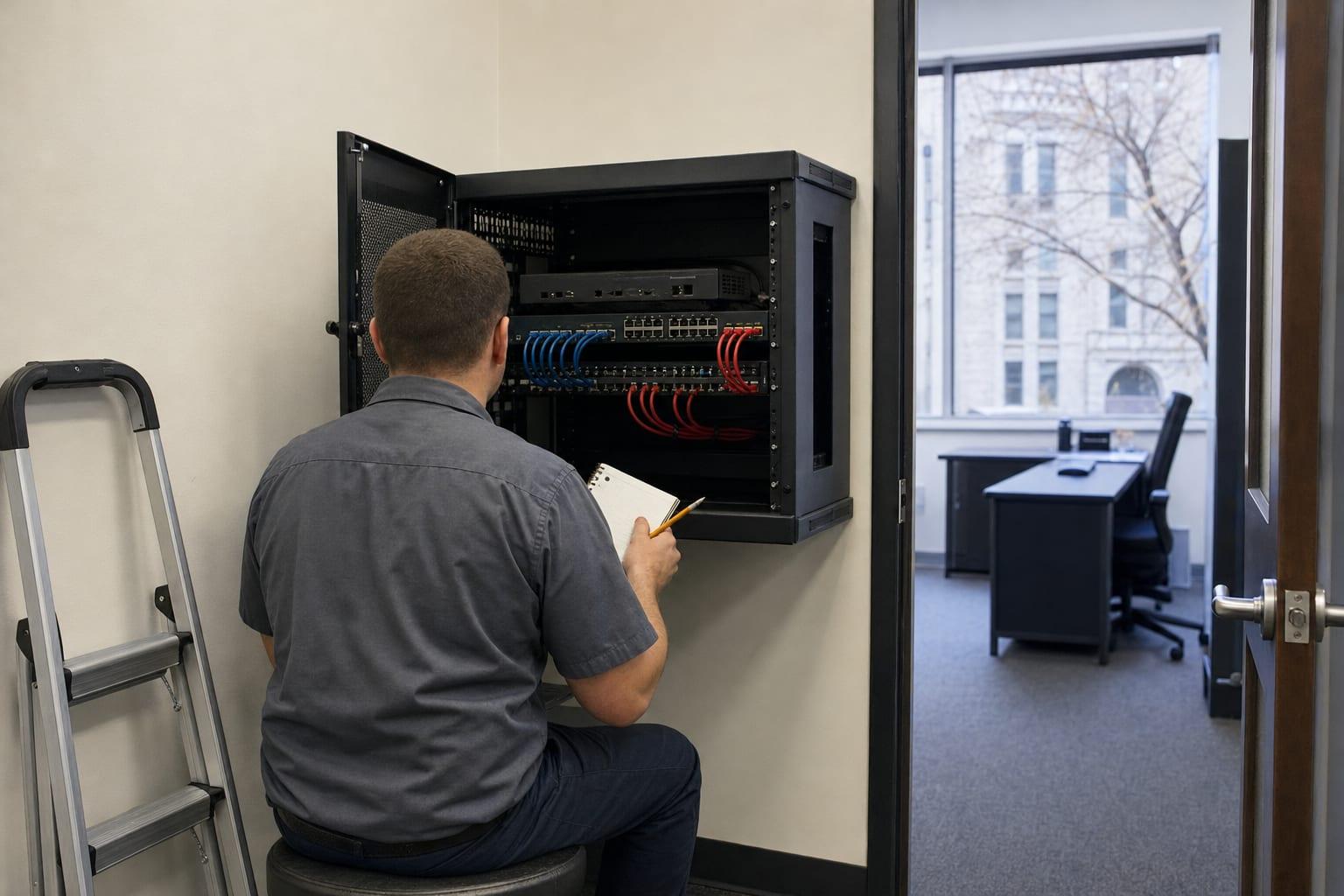
Label Both Ends
Structured Cabling in Indianapolis, Indiana
Does anyone know where jack 14 goes?
Network Cabling Installation in Indianapolis
Structured cabling in Indianapolis is the installation of Cat6, Cat6A and fiber lines that connect your desks, access points, cameras and phones to the network closet. Every run is terminated, labeled and tested. Send a floor plan to contact@managedserviceproviderindianapolis.com for a custom quote.
Bad cabling looks like other problems. A PC that connects at a tenth of its proper speed. An access point that reboots under load. A phone that crackles. Swap the device and the fault stays, because the fault is in the wall.
Cabling is also the one part of IT you cannot easily redo. Once the ceiling is closed and the furniture is in, adding a drop costs several times what it would have cost during the build. Plan the count with room to spare.
Structured Cabling Services: Cat6, Fiber and Testing
A cabling job is judged by what you cannot see. These six items separate a tested installation from a pile of blue wire.
Cat6 and Cat6A Drops
Copper runs to desks and ceilings. Cat6A carries 10-gigabit to the full 328 feet and suits new access points.
Fiber Backbone
Fiber between closets, floors or buildings, where copper would run past its distance limit.
Patch Panels and Racks
Every cable lands on a numbered panel in a rack or wall cabinet instead of dangling from the ceiling.
Labeling
The number on the wall plate matches the number on the panel. Both ends, every run.
Testing
Each line is tested end to end and the results are handed over, so a bad termination is caught before move-in.
Cleanup of Old Cable
Dead runs are traced and removed, and the closet is dressed so the next technician can work in it.

How a Cabling Project Runs
Floor Plan Review
Desk positions, access points, cameras and printers are marked on a drawing.
Site Visit
Ceiling type, pathways and the closet location are checked in person.
Quote
Drop count, cable type and any rack work are priced line by line.
Pull and Terminate
Cable is run, supported properly and punched down at both ends.
Test and Label
Every run is tested and numbered, and the map is delivered.
Why Choose Us for Structured Cabling?
Test Results Handed Over
You get a report for every run, not a verbal assurance that it works.
Right Cable for the Ceiling
Plenum spaces get plenum-rated cable, as fire code requires.
Spare Capacity Planned
Extra drops and open panel ports are discussed while they are still cheap.
A Closet You Can Read
Cables are dressed, numbered and documented on a one-page map.

Structured Cabling Cost per Drop
| Option | Price | What Sets the Price |
|---|---|---|
| Copper data drops | Custom quote | Drop count, cable category and ceiling access |
| Fiber runs | Custom quote | Distance, fiber type and number of strands |
| Rack and closet build | Custom quote | Rack size, patch panels and power |
Per-drop pricing hides a lot. Plenum-rated cable for air-handling ceilings costs more than standard cable. Hard ceilings and long runs add labor. Ask whether test results and labeling are included, because some low bids leave both out.
Talk to an Indianapolis IT Team
How many drops, and is the ceiling open yet?
Call (765) 534-2517Get a Free Quote
No obligation.
Areas We Cover in Indiana
Structured Cabling Questions
What is structured cabling?
Structured cabling is an organized system of network cables, wall jacks, patch panels and racks that connects every device in a building to one or more central closets. It follows published standards, so any technician can read and extend it later.
Should I install Cat6 or Cat6A?
Cat6 is enough for most desks and phones. Cat6A is the better choice for wireless access points and any run that may carry 10-gigabit traffic, because Cat6 supports that speed only over shorter distances. The price gap is small next to the labor.
How long can an Ethernet cable run be?
An Ethernet cable run can be up to 100 meters, or 328 feet, from switch to device. That figure includes the patch cords at both ends. Longer distances need fiber or an intermediate switch. Runs near the limit should be tested, not assumed.
When should cabling be done during an office build-out?
Cabling should be pulled after framing and before the ceiling grid and drywall are closed. Bring the installer in during design so the closet, power and pathways are on the drawings. Calling after the walls are painted raises the cost sharply.
Our Services in Indianapolis, IN
- Managed IT Services
- Small Business IT Support
- IT Support
- IT Services
- IT Consulting
- IT Help Desk
- Cybersecurity
- Penetration Testing
- Network Support
- Business Phone Systems
- Security Camera Installation
- Access Control
- Conference Room AV
- IT Compliance
- Remote IT Support
- IT Onboarding and Offboarding
- Application Support
- Printer Support